
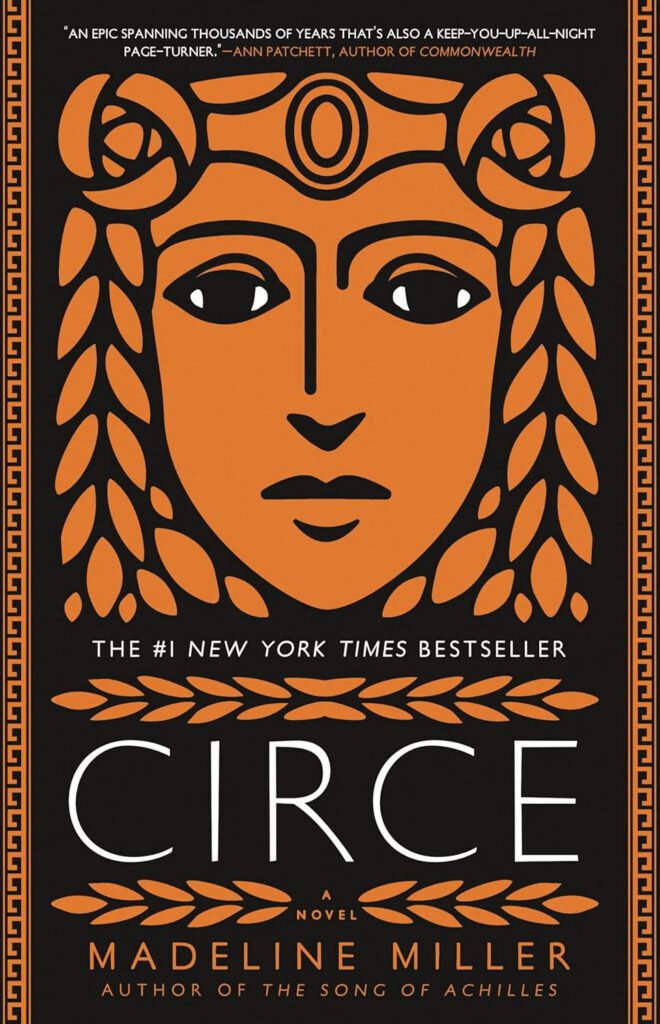
Circe
Also available on: Kindle, Audible
Synopsis
“Circe” (2018) by Madeline Miller is a lush, lyrical reimagining of Greek mythology that takes a minor character from Homer’s Odyssey and transforms her into a complex, feminist icon. While traditional myths paint Circe as a dangerous “temptress” who turns men into pigs, Miller reframes her story as a journey of self-discovery, resilience, and the power of being “the first of her kind.”
The Plot: From Outcast to Goddess
The novel spans centuries, following the life of Circe, the daughter of Helios, the sun god, and Perse, a beautiful but cold nymph.
-
The Misfit: Unlike her siblings, Circe has no divine power—or so it seems. She is mocked by the gods for her “yellow eyes” and her voice, which sounds like a human’s.
-
The Discovery of Witchcraft: Driven by loneliness and unrequited love, Circe discovers pharmakeia—the power of herbs and spells. She uses it to transform a rival into the monster Scylla, a deed that both terrifies the gods and reveals her true nature as the world’s first witch.
-
The Exile: Fearing her power, Zeus and Helios banish her to the deserted island of Aiaia. It is here, in isolation, that Circe truly comes into her own, taming lions and perfecting her craft.
Key Figures in Circe’s Life
As she lives through the ages, her island becomes a crossroads for some of the most famous figures in mythology:
-
Daedalus: The master craftsman with whom she shares a brief, tender connection based on their shared status as “creators” in a world of “destoyers.”
-
The Minotaur: Circe travels to Crete to help her sister, Pasiphaë, give birth to and bind the legendary monster.
-
Hermes: The messenger god who becomes her casual lover and a source of news from the outside world.
-
Odysseus: The famous hero who stays on her island for a year. Miller subverts the Odyssey by showing Odysseus through Circe’s eyes—not as a flawless hero, but as a brilliant, war-weary man prone to cruelty.
Key Themes: Mortality and Agency
1. The Burden of Immortality
Miller portrays the gods as petty, bored, and incapable of change. Circe’s “human” voice and her capacity for empathy make her an outcast among the divine but allow her to connect with the mortal world. The novel asks: Is a life without end meaningful if it contains no growth?
2. Witchcraft as Labor
In this version of the myth, magic isn’t a “gift” from the gods; it is a craft. Circe has to study, experiment, and work with her hands. It is a metaphor for female agency—finding power in a world designed to keep you powerless.
3. Protection and Motherhood
The latter part of the book focuses on Circe’s fierce protection of her son, Telegonus. She defies even Athena to keep him safe, transforming the island of Aiaia from a prison into a fortress.
Why It’s a 2026 Modern Classic
In 2026, Circe remains the gold standard for “mythic retellings.”
-
The Prose: Miller’s writing is frequently described as “golden”—warm, detailed, and incredibly sensory.
-
The “Other” Perspective: Like Wicked did for the Wicked Witch, Circe gives a voice to a woman who was silenced for thousands of years.
-
The Ending: The novel concludes with a powerful, choice-driven ending that challenges the traditional fate of a goddess.