
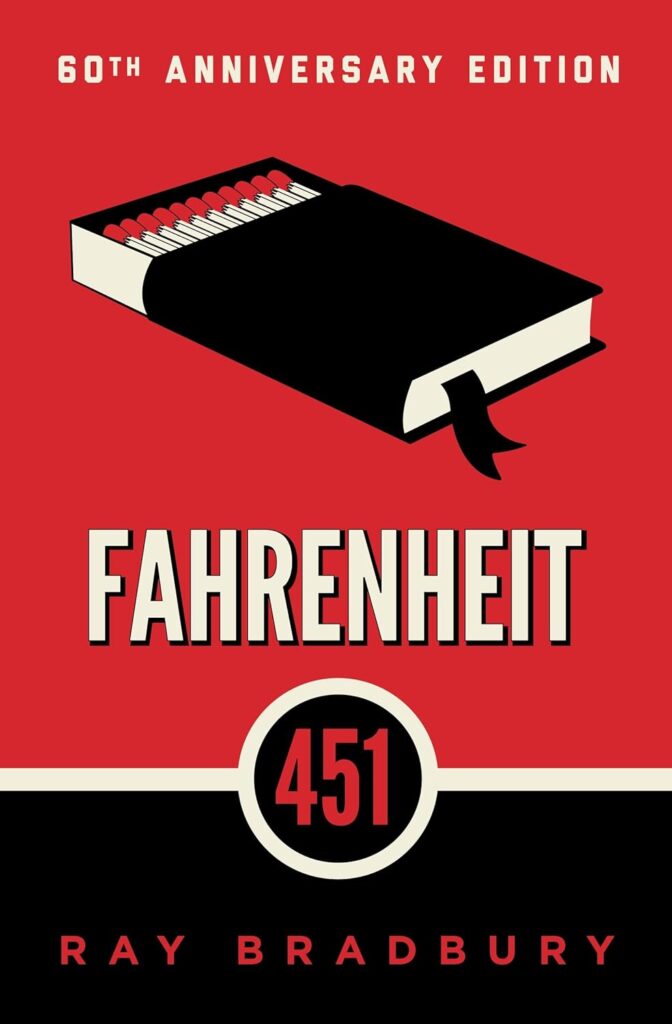
Fahrenheit 451
Also available on: Kindle, Audible
Synopsis
“Fahrenheit 451” (1953) by Ray Bradbury is a landmark of dystopian literature. Set in a future American society where books are outlawed and “firemen” start fires rather than putting them out, the novel is a chilling warning not just about government censorship, but about a culture that chooses entertainment and “mindlessness” over deep thought.
The title refers to the temperature at which book paper catches fire and burns.
The Plot: The Awakening of Guy Montag
Guy Montag is a fireman who takes pride in his work, smelling of the kerosene that he uses to incinerate illegal libraries. His world is turned upside down by two people:
-
Clarisse McClellan: A teenage neighbor who asks him, “Are you happy?” Her curiosity and love for nature make Montag realize how empty his life is.
-
Mildred Montag: His wife, who is addicted to her “parlor walls” (giant interactive TVs) and “seashell” earbuds, representing a society that has drugged itself into a state of constant, shallow distraction.
After witnessing an old woman choose to burn alive with her books rather than live without them, Montag steals a Bible. He begins a dangerous journey to understand what is in books that makes them worth dying for.
Key Concepts and Symbols
The Mechanical Hound
A terrifying robotic predator used by the firemen to track down and kill “dissidents.” It represents the perversion of technology—using high-tech machinery not to help humanity, but to enforce state-mandated conformity.
The “Parlor Walls” and “Seashells”
Bradbury was incredibly prophetic. In 1953, he predicted:
-
Large Flat-Screen TVs: Which the characters treat as their “family.”
-
Wireless Earbuds: Used to drown out silence and conversation with a constant stream of music and news.
-
Social Isolation: People are “connected” to the media but completely disconnected from each other.
Captain Beatty: The Intellectual Villain
Montag’s boss, Captain Beatty, is one of literature’s most complex villains. He is well-read and can quote literature extensively, but he uses that knowledge to argue why books should be destroyed. He claims books cause “unhappiness” by presenting conflicting ideas, and that a happy society is one where everyone thinks the same.
The Philosophy: Censorship from Below
A common misconception is that the government in Fahrenheit 451 forced the book ban on the people. Beatty explains that the people voted for it.
-
The “Numbing” of the Mind: As media became faster and “snappier,” people lost the patience for long-form thought.
-
Offense Culture: Every minority group and special interest found something offensive in books, so eventually, it was easier to just burn them all to keep everyone “happy.”
Why It’s a 2026 Essential
In 2026, Bradbury’s themes of digital distraction and the shortening of attention spans feel like daily news.
-
The War on Focus: As we grapple with “doomscrolling” and algorithm-driven content, Montag’s struggle to read a single page of a book is highly relatable.
-
The “Book People”: The novel ends with a hope for the future—a group of exiles who have each memorized a book to preserve it for a time when the world is ready to read again.