
Flashlight
Also available on: Kindle
Synopsis
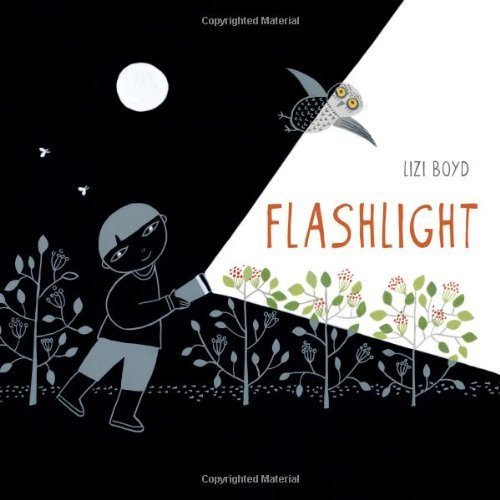
“Flashlight” by Lizi Boyd (2014) is a celebrated masterpiece of wordless picture books. It is a visual narrative that captures the magic of the night, the curiosity of childhood, and the shift in perspective that happens when we literally “shine a light” on the unknown.
The Concept: Seeing in the Dark
The book follows a young child who steps out of a tent at night with a flashlight. Most of the pages are printed on heavy, dark grey or black paper, representing the shadows of the woods. However, wherever the “beam” of the flashlight hits, the page erupts into vibrant color and detail.
-
The Magic of the “Beam”: Boyd uses a clever illustrative technique where the flashlight’s path is a die-cut or a brightly colored circle against the dark background.
-
The “Hidden” World: In the dark, the woods seem silent and empty. But the flashlight reveals a bustling world: an owl in a tree, a family of foxes, a mouse under a leaf, and a spider spinning its web.
Key Features and Style
-
Wordless Narrative: Because there is no text, the “reader” (often a child and parent) must tell the story themselves. This encourages observation, as the child looks for clues in the dark areas of the page that will be “revealed” later.
-
Die-Cut Elements: The book features small cut-outs that allow you to peek through to the next page, mimicking how a flashlight reveals only a small portion of the world at a time.
-
The “Switch”: The story takes a charming turn at the end when the animals take the flashlight from the boy, turning the “light” back on him and revealing his world from their perspective.
Why It’s a 2026 Childhood Staple
Even though it was released over a decade ago, Flashlight remains a top recommendation for early childhood development for several reasons:
-
Overcoming Fear of the Dark: It reframes the “scary” woods as a place of wonder and community, showing that the dark isn’t empty—it’s just “unlit.”
-
Visual Literacy: It teaches children to look for details, patterns, and cause-and-effect without relying on written language.
-
Tactile Experience: In an increasingly digital world, the physical nature of this book—the paper quality, the die-cuts, and the play of light—makes it a favorite for “screen-free” bedtime routines.
Recommendation
If you love the quiet, observant style of Lizi Boyd, you should also check out her other works like “Inside Outside” or “I Wrote on All the Walls,” which use similar visual tricks to explore the relationship between our internal and external worlds.