
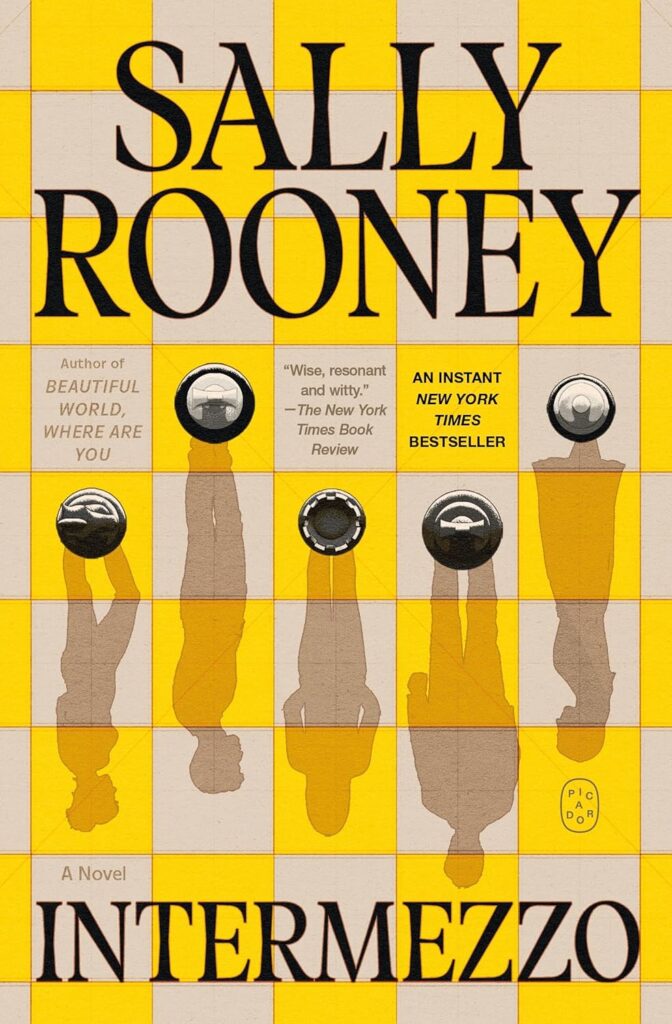
Intermezzo
Also available on: Kindle, Audible
Synopsis
“Intermezzo” (2024) is the fourth novel by Sally Rooney, the author who defined the “Millennial” literary voice with Normal People. In Intermezzo, Rooney moves away from her usual focus on young, collegiate romance to explore the complex, jagged relationship between two grieving brothers.
The Premise: The Koubek Brothers
The story is set in Dublin following the death of the brothers’ father. The title, a musical term for a “connecting movement” between two larger parts of a composition, reflects the “in-between” state of the characters’ lives.
-
Peter Koubek: In his early thirties, Peter is a high-achieving, charismatic human rights lawyer. On the surface, he is successful, but he is privately spiraling, self-medicating with sleep aids and alcohol as he struggles to choose between two women: his first love, Sylvia, who suffered a life-altering injury, and Naomi, a chaotic college student.
-
Ivan Koubek: At twenty-two, Ivan is a socially awkward, hyper-logical competitive chess player. He has always felt like the “unloved” younger brother. His life changes when he begins a controversial, deeply sincere romance with Margaret, a woman fourteen years his senior who is recently separated.
Key Themes: Grief and Social Class
-
The Language of Grief: Rooney uses a distinct prose style for each brother. Peter’s sections are often fragmented and staccato, reflecting his fractured mental state, while Ivan’s are more linear and observational.
-
Age and Power: The novel heavily scrutinizes age gaps in relationships—both Peter’s relationship with a much younger woman and Ivan’s relationship with an older woman. It asks whether love can be “ethical” when the power balance is skewed.
-
Brotherly Rivalry: Much of the tension comes from the “long-standing” resentment between the two. They are fundamentally different people who are forced to confront one another without their father acting as a buffer.
Why It’s a 2026 Literary Staple
By 2026, Intermezzo has been hailed as Rooney’s most “mature” work. While her earlier books were often criticized for being “aloof,” this novel is deeply emotional and philosophical.
-
The Chess Motif: Chess serves as a metaphor for the characters’ lives—calculating moves, anticipating the opponent, and finding “intermezzos” (pauses) where they can breathe.
-
Dublin Aesthetic: Like her previous works, the setting is a character itself, capturing a modern, rainy, and intellectually dense Dublin.