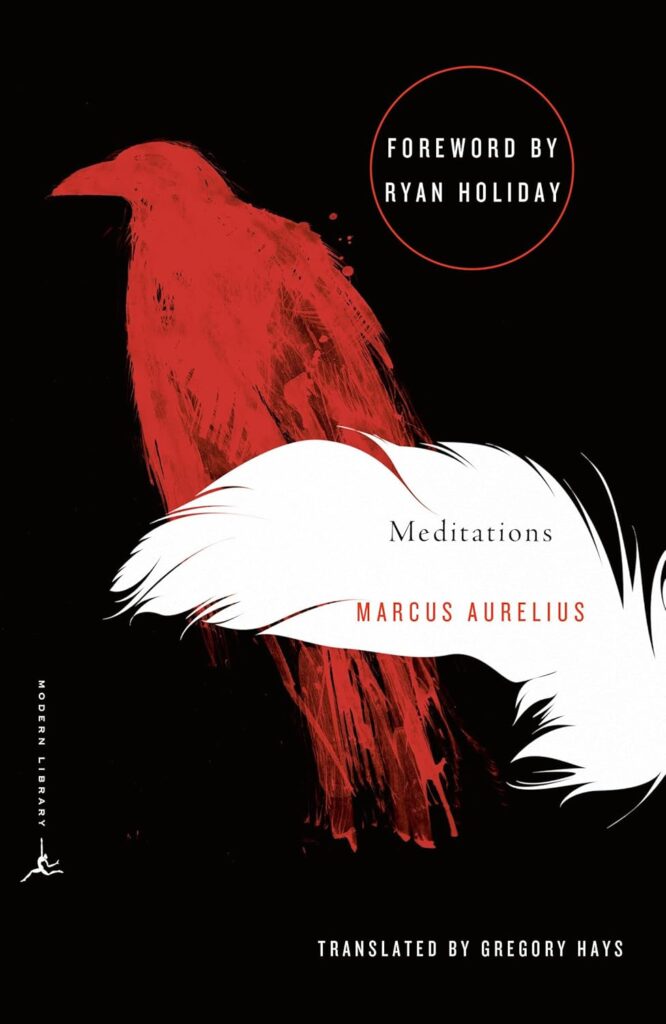
Meditations
Also available on: Kindle, Audible
Synopsis
“Meditations” by Marcus Aurelius is perhaps the most famous work of Stoic philosophy. Written between 161 and 180 AD, it was never intended for publication; it was the private journal of the most powerful man on Earth at the time—the Roman Emperor.
The Context: A King’s Private Diary
Marcus Aurelius wrote these “notes to himself” while on campaign on the Danubian frontier. He was dealing with constant warfare, the “Antonine Plague” that was decimating his empire, and the betrayal of his closest friends. Meditations wasn’t a philosophical treatise written from an ivory tower; it was a survival manual for a man trying to remain “good” in a world of chaos.
Core Pillars of Stoicism in Meditations
1. The Dichotomy of Control
This is the foundational Stoic principle. Marcus constantly reminds himself that we have no control over external events (fame, health, the weather, other people’s opinions), only over our internal response to them.
“You have power over your mind—not outside events. Realize this, and you will find strength.”
2. Memento Mori (“Remember You Must Die”)
Marcus uses the inevitability of death not to be morbid, but as a tool for focus. If you could die tomorrow, it shouldn’t matter what people think of you today; what matters is acting with justice and kindness now.
3. Amor Fati (“Love of Fate”)
He argues that since nature (the Logos) is a rational system, everything that happens is necessary for the whole. Instead of complaining about “bad luck,” a Stoic should embrace their circumstances as the “fuel” for their character.
4. The Obstacle is the Way
Marcus writes that “the impediment to action advances action. What stands in the way becomes the way.” Every difficulty is an opportunity to practice a specific virtue, like patience or courage.
Why It’s Resurging in 2026
In an era of digital noise and global instability, Meditations has become a “secular bible” for CEOs, athletes, and anyone seeking mental clarity. It’s often paired with modern works like Ryan Holiday’s The Obstacle Is the Way.