
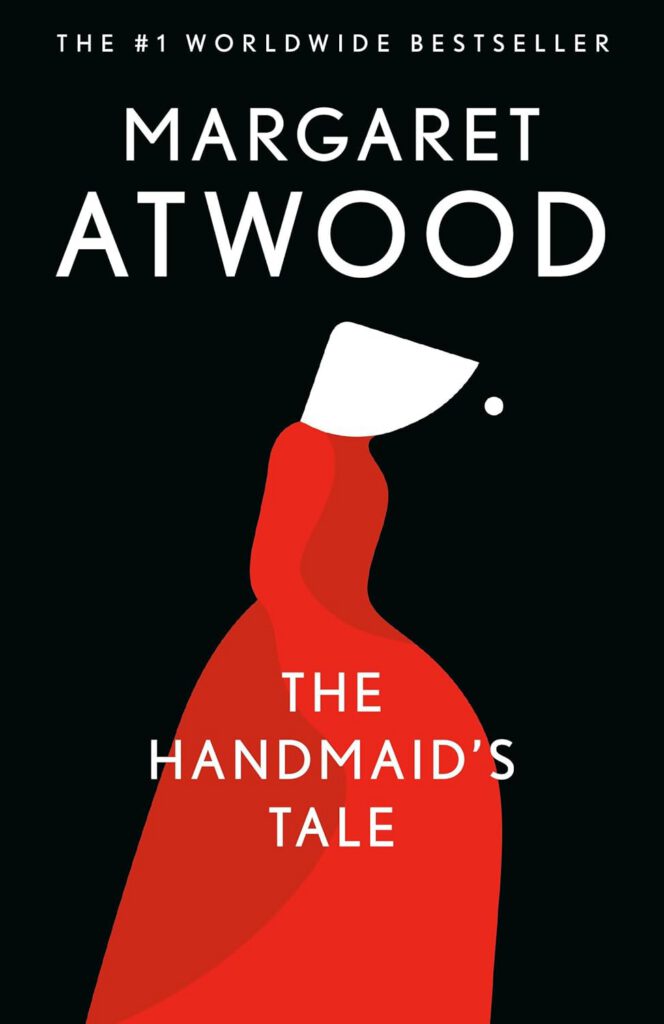
The Handmaid’s Tale
Also available on: Kindle, Audible
Synopsis
“The Handmaid’s Tale” (1985) by Margaret Atwood is a seminal work of speculative fiction that has become a global symbol of resistance. Set in the near-future Republic of Gilead—a totalitarian, theocratic state that has overthrown the United States government—the novel explores themes of power, gender, and the erosion of human rights.
The World of Gilead
In a world facing a birthrate crisis due to environmental toxins and radiation, Gilead has restructured society into a rigid caste system based on a literalist, patriarchal interpretation of the Bible.
-
The Handmaids: Fertile women who are assigned to the homes of the ruling elite (“Commanders”) to bear children through a ritualized, non-consensual process known as “The Ceremony.” They are stripped of their names and called by a patronymic (e.g., Offred—”Of-Fred”).
-
The Marthas: Domestic servants who cook and clean.
-
The Wives: The highest-ranking women, married to Commanders, who “raise” the children born to Handmaids.
-
The Aunts: Older, devout women tasked with indoctrination and discipline at the “Red Center.”
The Plot: Offred’s Narrative
The story is told through the eyes of Offred, a woman who remembers the “time before”—a time when she had a job, a bank account, a husband (Luke), and a daughter.
-
The Rebellion of the Mind: Much of the novel’s tension is internal. Offred’s “resistance” is her memory and her internal monologue, which refuses to let Gilead erase her true self.
-
The Commander and Serena Joy: Offred’s life is complicated by the Commander’s desire for an intellectual relationship outside of the law, and Serena Joy’s (the Wife) desperate, manipulative quest for a child.
-
The Secret Organization: Offred learns of “Mayday,” an underground network working to topple the regime, and is forced to navigate a world where anyone could be an “Eye” (a government spy).
Key Themes: Control and Complicity
1. Language as Power
Gilead controls thought by controlling speech. Characters use ritualized greetings like “Blessed be the fruit” and “May the Lord open.” Forbidden words, like the names of flowers or body parts, become acts of rebellion when thought or spoken in private.
2. The Slow Erosion of Rights
Atwood famously stated that she did not include any event in the book that had not already happened in human history. The “flashing back” to the transition period—where women’s bank accounts were suddenly frozen and their rights stripped overnight—serves as a warning about the fragility of democracy.
3. Complicity
The novel examines how women are used to oppress other women. The Aunts, particularly Aunt Lydia, are some of the most brutal enforcers of the regime, proving that power is often maintained by turning marginalized groups against one another.
Why It’s a 2026 Cultural Icon
In 2026, the book’s influence is visible everywhere, from political protests where activists wear the iconic red robes and white wings to the ongoing popularity of the Hulu television adaptation.
-
The Historical Notes: The novel ends with an “epilogue” set in the year 2195, at a dynamic academic conference. It reveals that Gilead eventually fell, but it serves as a chilling reminder of how historians often “dispassionately” analyze human suffering.
-
The Testaments: In 2019, Atwood released the sequel, The Testaments, which provides more detail on the inner workings of Gilead and its ultimate collapse.