
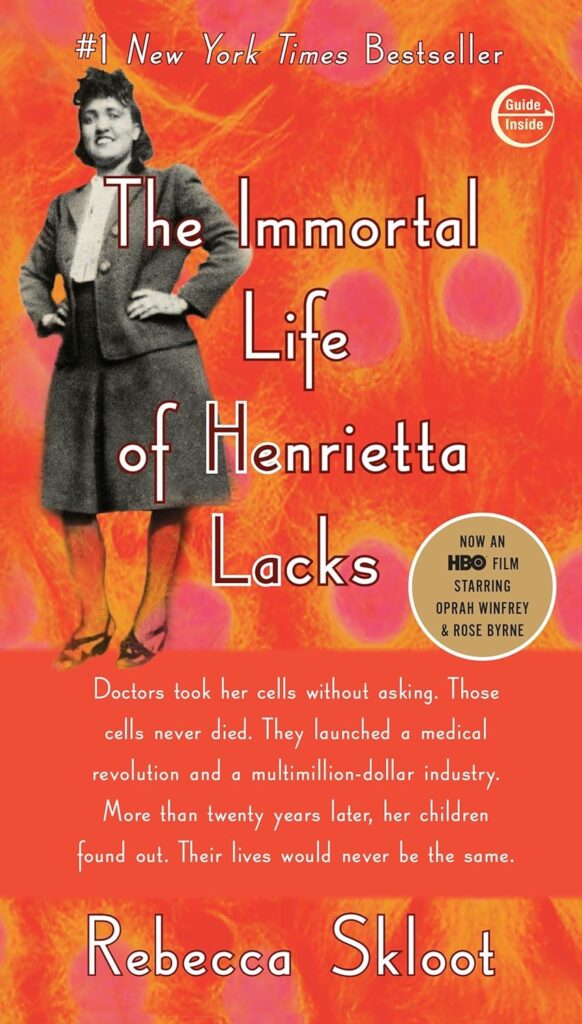
The Immortal Life of Henrietta Lacks
Also available on: Kindle, Audible
Synopsis
“The Immortal Life of Henrietta Lacks” by Rebecca Skloot (2010) is a towering work of narrative non-fiction that sits at the intersection of science, ethics, and racial history. It tells the story of HeLa, the first “immortal” human cell line, and the woman from whom those cells were taken without her knowledge or consent.
The Story: Two Parallel Narratives
The book expertly weaves together two distinct timelines:
1. The Science of HeLa
In 1951, Henrietta Lacks, a poor Black tobacco farmer and mother of five, was diagnosed with cervical cancer at Johns Hopkins Hospital. During her treatment, a surgeon took a sample of her tumor and sent it to Dr. George Gey.
Unlike any other cells ever studied, Henrietta’s cells survived and doubled every 24 hours. These “HeLa” cells became a multi-billion dollar industry, essential to:
-
Developing the polio vaccine.
-
Research into cancer, AIDS, and gene mapping.
-
Testing the effects of radiation and zero gravity in space.
2. The Lacks Family’s Journey
While Henrietta’s cells were being bought and sold worldwide, her family remained in poverty, often unable to afford health insurance. They didn’t learn about the “immortality” of their mother’s cells until 25 years after her death.
Skloot spent a decade building a relationship with Henrietta’s daughter, Deborah Lacks, to uncover the human story behind the laboratory code. It is a deeply emotional journey about a family trying to reclaim their mother’s identity from the cold world of clinical science.
Key Themes: Ethics and Injustice
-
Informed Consent: The book explores the dark history of medical experimentation on Black Americans and the lack of legal protections for patients’ biological materials.
-
The Dehumanization of Science: For decades, Henrietta was known only as “HeLa.” Skloot’s work was instrumental in giving her back her name and story.
-
Scientific Breakthrough vs. Personal Cost: It asks the uncomfortable question: Can we celebrate medical progress if it was built on a foundation of exploitation?
Why It Remains Vital in 2026
-
Genetic Privacy: As at-home DNA testing and genomic sequencing become ubiquitous, the debate over who “owns” your cells is more relevant than ever.
-
Health Equity: The book is frequently used in medical schools to teach bioethics and the importance of trust between doctors and marginalized communities.
-
The HBO Movie: The 2017 film starring Oprah Winfrey (as Deborah Lacks) continues to bring new readers to the book every year.