
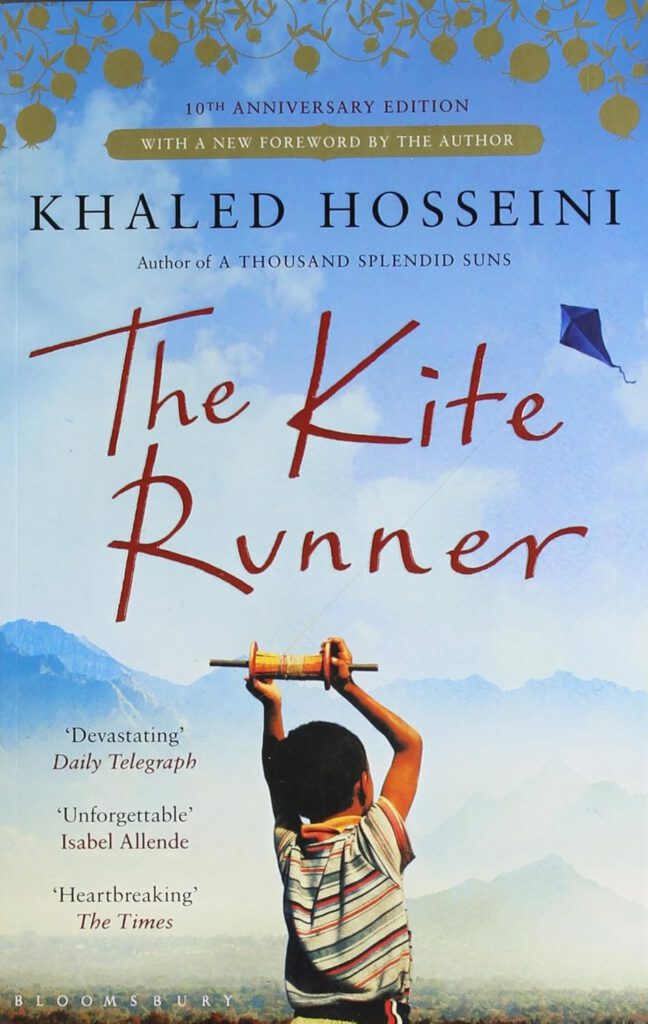
The Kite Runner
Also available on: Kindle, Audible
Synopsis
The Kite Runner by Khaled Hosseini (2003) is a modern classic that remains one of the most powerful and emotionally taxing stories of the 21st century. It is a tale of betrayal, guilt, and the grueling path toward redemption, set against the backdrop of Afghanistan’s transition from a peaceful monarchy to a war-torn state under the Taliban.
The Plot: “A Thousand Times Over”
The story is narrated by Amir, a privileged Pashtun boy in 1970s Kabul. His closest companion is Hassan, the son of his father’s Hazara servant. Hassan is legendary for his loyalty and his skill as a “kite runner”—the one who retrieves fallen kites after a battle.
The central tragedy occurs after a kite-fighting tournament. Hassan is assaulted by a neighborhood bully, Assef, while protecting the kite Amir just won. Amir witnesses the attack from the shadows but is too paralyzed by cowardice to intervene. This moment of betrayal, and Amir’s subsequent framing of Hassan for theft to get him sent away, becomes the “ghost” that haunts Amir for decades, even after he and his father (Baba) flee to California as refugees.
Years later, a call from his father’s old friend, Rahim Khan, offers Amir a chance at atonement: “There is a way to be good again.” Amir must return to Taliban-controlled Afghanistan to rescue Hassan’s son, Sohrab, who is being held by the same man who destroyed Hassan’s life years ago.
Key Themes
- The “Father’s Shadow”: Much of Amir’s early life is driven by a desperate, toxic need for his father’s approval. Baba is a “manly” Afghan hero who finds Amir’s love for poetry and stories weak.
- Ethnic and Religious Tension: The book highlights the historical persecution of the Hazara minority (Shia) by the Pashtun majority (Sunni), showing how systemic racism fueled the personal betrayals in the story.
- The Immigrant Experience: The middle section of the book provides a grounded look at the Afghan diaspora in America—the loss of status, the preservation of culture, and the “haunting” nature of the homeland.
- Cyclical Redemption: The novel is famously cyclical. It begins with Hassan running a kite for Amir and ends with Amir running a kite for Hassan’s son.
Book vs. Movie (2007)
The film is generally well-regarded but “sanitizes” much of the novel’s brutality to reach a wider audience.