
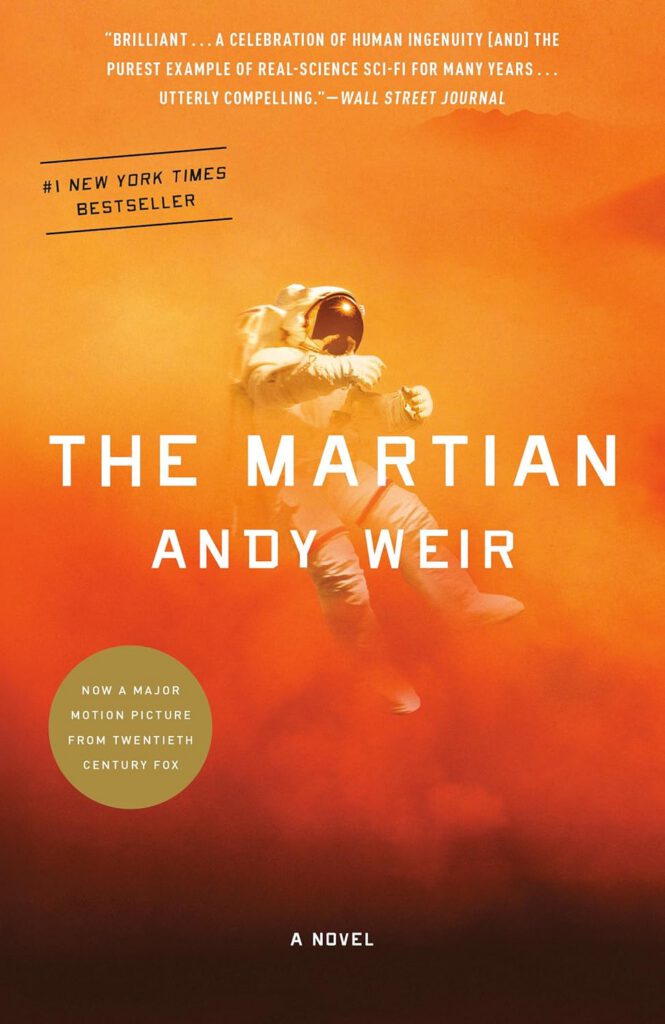
The Martian
Also available on: Kindle, Audible
Synopsis
“The Martian” (2011) by Andy Weir is the gold standard for “hard” science fiction. Originally self-published as a blog series, it is celebrated for its rigorous scientific accuracy—the author even wrote custom software to calculate the orbital trajectories used in the book.
The Plot: “I’m going to have to science the sh*t out of this.”
Set in the near future (around 2035), the story follows Mark Watney, a botanist and mechanical engineer on the Ares 3 mission to Mars. During a severe dust storm, the crew is forced to evacuate. Watney is hit by a flying antenna, presumed dead, and left behind.
He wakes up alone on a planet that is actively trying to kill him. With no way to contact Earth and only enough food to last a few months, Watney must use his scientific ingenuity to survive for the four years it will take for the next planned mission to arrive.
The Three Survival Pillars
1. Botany (The Potatoes)
Watney’s most famous feat is creating a farm inside the Mars Habitat (“The Hab”). He uses Martian soil, vacuum-packed Earth potatoes intended for a Thanksgiving meal, and—most notoriously—the crew’s dehydrated waste as fertilizer.
2. Chemistry (The Water)
To grow the potatoes, he needs water. He meticulously (and dangerously) reduces hydrazine rocket fuel into hydrogen and nitrogen, then burns the hydrogen in the Hab’s atmosphere to create .
3. Engineering (Pathfinder)
Watney travels hundreds of kilometers across the Martian surface in a modified rover to recover the Pathfinder lander (which went silent in 1997). By using its camera to communicate with NASA via hexadecimal code, he finally alerts Earth that he is alive.
Key Themes: Optimism and Logic
-
Problem Solving: Unlike many survival stories that focus on psychological breakdown, The Martian is about the “Next Step.” Watney’s mantra is to solve one problem, then the next, until he can finally come home.
-
The Global Village: When NASA discovers Watney is alive, the rescue effort becomes a global phenomenon, involving the China National Space Administration and a daring mutiny by his own crew on the Hermes spacecraft.
-
Humor as a Survival Tool: Watney’s sarcastic, “wise-ass” internal monologue is what prevents the book from becoming a dry technical manual. His hatred for the Commander’s disco music collection becomes a running gag.
Why It’s a 2026 Classic
In early 2026, The Martian feels more relevant than ever.
-
Real-World Parallels: With NASA’s Artemis missions and the successful operation of the MOXIE experiment (which actually produced oxygen on Mars in the 2020s), much of Weir’s “speculation” has become scientific reality.
-
The “Science Hero”: Watney redefined the “action hero” as someone whose primary weapon is a calculator and a thorough understanding of the Laws of Thermodynamics.