
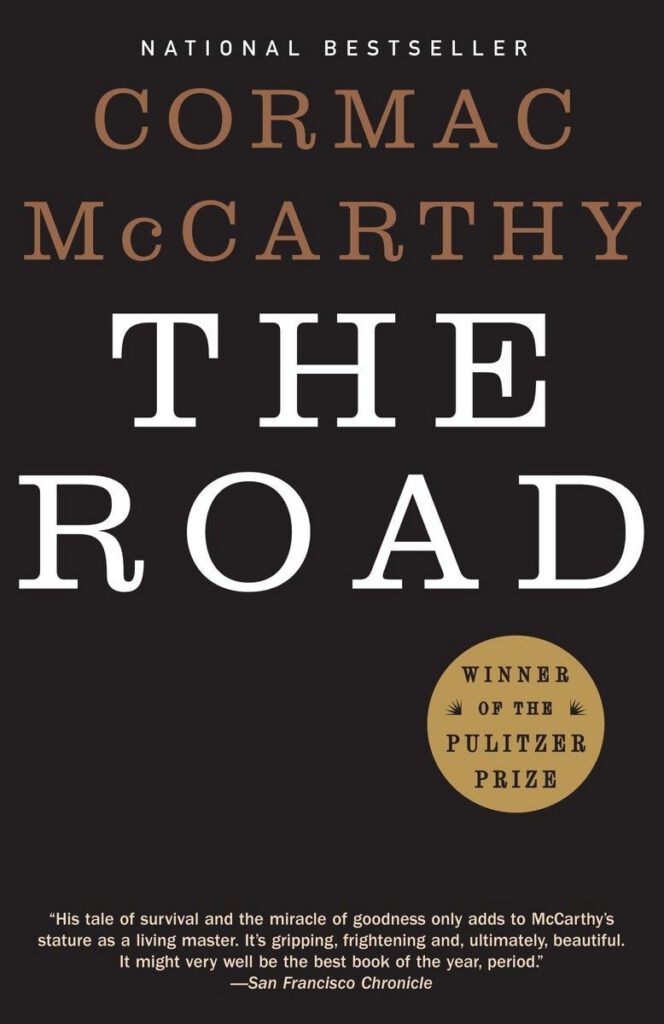
The Road
Also available on: Kindle, Audible
Synopsis
The Road by Cormac McCarthy (2006) is a Pulitzer Prize-winning masterpiece that is often cited as one of the most harrowing and beautiful works of post-apocalyptic fiction. Written in McCarthy’s signature sparse, punctuation-free style, it is a meditation on the limits of endurance and the “fire” of humanity.
The Plot: A Journey Through Ash
The story follows an unnamed father and his young son as they trudge across a decimated American landscape years after an unspecified cataclysm (likely nuclear or volcanic, given the perpetual ashfall).
The world is dead—no animals, no green plants, only “the gray snow.” They are traveling south toward the coast to escape the lethal winter, pushing a shopping cart containing their meager survival gear. Their primary threats are starvation, freezing temperatures, and “road agents”—roaming bands of cannibals who have abandoned all morality. The father’s sole purpose is to protect the boy, whom he views as a divine presence in a godless world.
Key Themes
- “Carrying the Fire”: This is the book’s central metaphor. The father tells the boy they are the “good guys” who must “carry the fire”—representing hope, civilization, and the refusal to succumb to the savagery around them.
- Paternal Love: The bond is “each the other’s world entire.” The father’s love is fierce and protective, while the boy’s love is compassionate, often challenging his father’s survival-first instincts.
- The Fragility of Civilization: McCarthy explores what remains when everything we know—cities, stores, law, and even the sun—is gone.
- Style as Substance: The lack of quotation marks and traditional grammar reflects the “stripped-back” nature of the world itself.
Comparison: The Novel vs. The 2009 Film
The film adaptation, starring Viggo Mortensen, is widely considered a faithful but slightly softened version of the source material.