
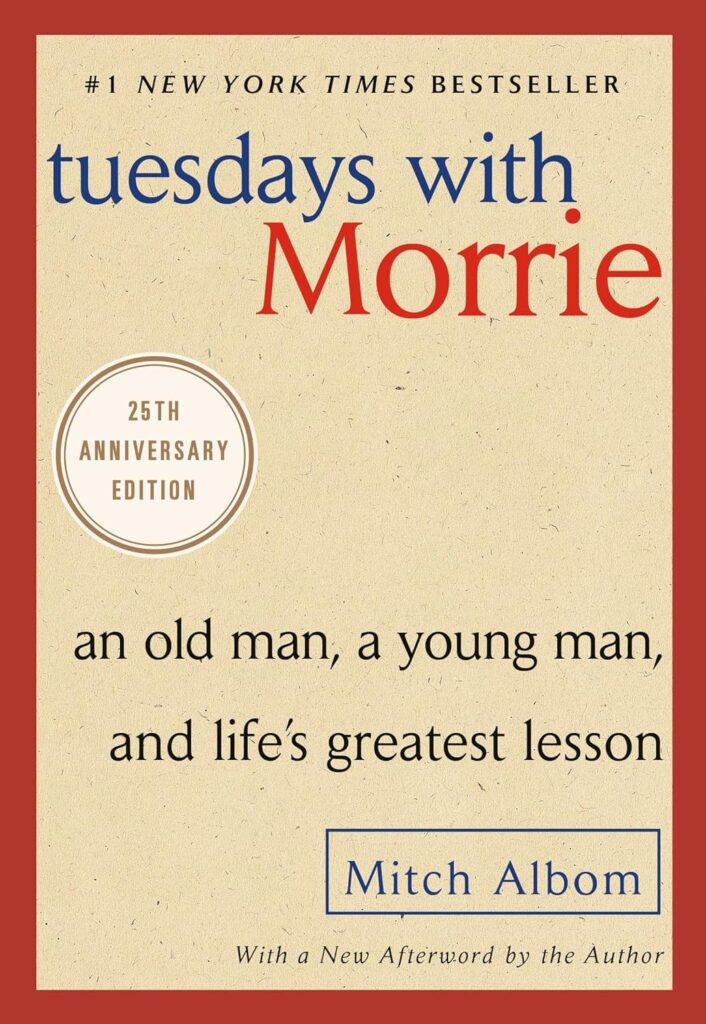
Tuesdays with Morrie
Also available on: Kindle, Audible
Synopsis
“Tuesdays with Morrie” (1997) by Mitch Albom is a poignant, non-fiction memoir that captures the final lessons of a dying professor. It is one of the best-selling memoirs of all time, serving as a “final thesis” on how to live a meaningful life, delivered from the perspective of someone who is about to leave it.
The Premise: The Last Class
The story begins when Mitch Albom, a successful but burned-out sports journalist, sees his former sociology professor, Morrie Schwartz, on Nightline. Morrie has been diagnosed with ALS (Lou Gehrig’s disease), a brutal condition that gradually “withers” the body while keeping the mind perfectly intact.
Mitch, realizing he has spent the sixteen years since graduation chasing money and status at the expense of his soul, decides to visit Morrie in Massachusetts. What was meant to be one visit turns into a weekly ritual. Every Tuesday, they meet to discuss a different topic, ranging from family and forgiveness to greed and death.
Morrie’s “Tuesday Lessons”
Morrie’s philosophy centers on the idea that “once you learn how to die, you learn how to live.” He challenges the “culture” of modern society, which he believes focuses on the wrong things.
Key Themes
-
The Rejection of Popular Culture: Morrie argues that we are brainwashed by a culture that values youth, beauty, and money over human connection.
-
Detachment: Morrie teaches Mitch how to “detach” from emotions. He doesn’t mean suppressing them; he means experiencing them fully (the pain, the fear, the grief) so that you can eventually say, “Okay, I have experienced that emotion. Now I must move on.”
-
The Importance of Compassion: As Morrie becomes physically dependent on others for everything from eating to using the bathroom, he views it not as a humiliation, but as an opportunity to return to the “dependency of childhood”—reminding Mitch that we need each other at both the beginning and the end of life.
Why It’s a 2026 Essential
In the mid-2020s, Tuesdays with Morrie has seen a resurgence as a “slow-living” manifesto.
-
The Burnout Antidote: For a generation facing digital overload and “productivity anxiety,” Morrie’s insistence on “being present” and “investing in people” feels like a necessary corrective.
-
The Universal Experience: Despite being nearly 30 years old, the book’s exploration of grief and mortality remains timeless. It is often used in grief counseling and end-of-life care discussions.