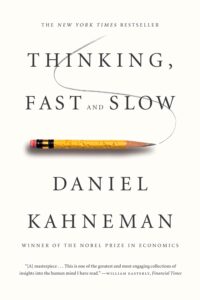
by Daniel Kahneman
14 discussion topics
2011
⭐ 4.17
“Thinking, Fast and Slow” (2011) by Daniel Kahneman, a Nobel Prize-winning psychologist, is widely considered the “Bible” of behavioral economics....
“Thinking, Fast and Slow” (2011) by Daniel Kahneman, a Nobel Prize-winning psychologist, is widely considered the “Bible” of behavioral economics. It dismantles the idea that humans are rational actors, instead revealing the messy, biased, and often hilarious ways our brains actually process information.
The Core Concept: Two Systems
Kahneman divides the human brain’s thought processes into two metaphorical “Systems”:
System 1: Fast & Intuitive
How it works: Automatic, emotional, and requires little to no effort.
Examples: Detecting that one object is more distant than another, finishing the phrase “bread and…”, or recoiling from a loud noise.
The Flaw: It is prone to “cognitive illusions” and relies on shortcuts (heuristics) that often lead to mistakes.
System 2: Slow & Deliberate
How it works: Analytical, logical, and requires intense focus. It’s what you use when you’re doing your taxes or learning to drive.
The Flaw: It is lazy. It prefers to “endorse” the quick suggestions of System 1 rather than doing the hard work of checking the math.
Why We Make Bad Decisions: Key Biases
Kahneman explores several “glitches” in our mental software that affect everything from our finances to our relationships:
Anchoring: Our tendency to rely too heavily on the first piece of information offered. (e.g., If a shirt was originally $100 but is now $50, we think it’s a “steal,” regardless of whether the shirt is actually worth $50).
Loss Aversion: The psychological pain of losing $100 is twice as powerful as the joy of gaining $100. This makes us irrationally “risk-averse.”
The Availability Heuristic: We overestimate the importance of information that is easy to remember. (e.g., Fearing a shark attack because you saw it on the news, even though the drive to the beach was mathematically more dangerous).
The Planning Fallacy: Our consistent tendency to underestimate how much time a task will take, even when we have failed to meet similar deadlines in the past.
The Two Selves: Experiencing vs. Remembering
In one of the book’s most profound sections, Kahneman distinguishes between:
The Experiencing Self: The one who lives through the moment (the “Does it hurt now?” self).
The Remembering Self: The one who keeps score and looks back.
He proves that our “Remembering Self” is a terrible historian. We tend to judge an entire experience (like a vacation) based on its peak (the best part) and its end, totally ignoring the total duration of the experience.
Why It’s a 2026 Essential
AI and Decision Making: As we delegate more choices to algorithms in 2026, understanding our own “human” biases is the only way to ensure we remain the masters of our technology.
The “Nudge” Economy: Governments and corporations use Kahneman’s findings to “nudge” us toward certain behaviors. Reading this book is like seeing the code behind the matrix of modern marketing.