by Richard Powers
14 discussion topics
2018
⭐ 4.04
“The Overstory” by Richard Powers (2018) is a Pulitzer Prize-winning masterpiece that shifts the perspective of the “Great American Novel”...
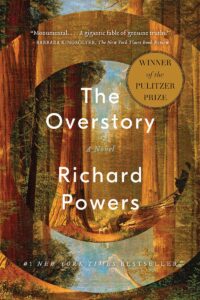
“The Overstory” by Richard Powers (2018) is a Pulitzer Prize-winning masterpiece that shifts the perspective of the “Great American Novel” away from humans and toward trees. It is a sprawling, multi-generational epic that argues humans are not the protagonists of the Earth, but merely a recent and often destructive subplot.
The Structure: The Anatomy of a Tree
The book is ingeniously organized like the life cycle of a tree:
1. Roots
The first section introduces nine distinct characters through short stories that span decades. We meet a pioneer family in Iowa, an engineer in the Vietnam War, and a brilliant, social-misfit scientist named Patricia Westerford (based loosely on real-life ecologist Suzanne Simard). Each character has a formative, often spiritual connection to a specific tree.
2. Trunk
The characters’ lives begin to intertwine as they are drawn together by a shared realization: the ancient forests of the Pacific Northwest are being decimated. They become activists, participating in “sit-ins” in the canopy of giant redwoods, risking their lives to stop the logging industry.
3. Crown
This section explores the aftermath of their activism—the legal battles, the personal sacrifices, and the long-term consequences of their “failure” to stop the machine of progress.
4. Seeds
The final section looks toward the future, suggesting that while individual humans (and even human civilizations) may fall, the “slow intelligence” of the forest will continue to adapt and endure.
Key Themes: “The Wood Wide Web”
Non-Human Intelligence: A central pillar of the book is the revolutionary (and scientifically accurate) idea that trees communicate, share nutrients, and warn each other of danger through underground fungal networks.
Plant Blindness: Powers critiques “plant blindness”—the human tendency to see trees as static background scenery rather than active, sentient beings.
Environmental Ethics: The novel asks a haunting question: When does “protecting the law” become a crime against the planet?
Why It’s a 2026 Essential
In the mid-2020s, The Overstory has transitioned from a popular novel to a cultural touchstone for the “Deep Ecology” movement.
The “Suzanne Simard” Effect: With the 2024-2025 surge in mainstream interest regarding fungal networks and forest communication, The Overstory is often cited as the book that “predicted” our current environmental consciousness.
The “Slow Read”: It is famously dense and lyrical. Readers in 2026 often use it as an “antidote” to the fast-paced, digital world—a book that requires the reader to slow down to the speed of a growing oak.