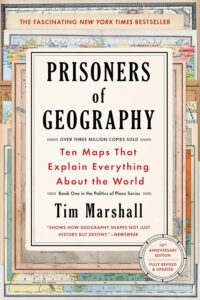
by Tim Marshall
14 discussion topics
2015
⭐ 4.17
“Prisoners of Geography: Ten Maps That Tell You Everything You Need to Help You Understand Global Politics” by Tim Marshall...
“Prisoners of Geography: Ten Maps That Tell You Everything You Need to Help You Understand Global Politics” by Tim Marshall (2015) is a seminal work in the field of geopolitics. It argues that while leaders and ideologies change, the physical realities of the earth—mountains, rivers, seas, and deserts—remain the permanent constraints that dictate the fates of nations.
The Core Thesis: “Geography as Destiny”
Marshall argues that geography is a fundamental “prison” for nations. A country’s foreign policy is often not a choice, but a response to its physical borders.
1. Russia: The Vulnerability of the North European Plain
Russia’s history is defined by its lack of a physical barrier to the West. The North European Plain is a flat corridor that has allowed invaders (Napoleon, Hitler) to march straight toward Moscow. This geographic reality explains Russia’s historical obsession with “buffer states” in Eastern Europe.
2. China: The Natural Fortresses
China is geographically protected by the Himalayas to the Southwest, the Gobi Desert to the North, and the Pacific Ocean to the East. Its primary geographic focus is “securing the periphery” (Tibet and Xinjiang) to ensure these natural barriers remain under its control.
3. The United States: The Geopolitcal Jackpot
Marshall describes the U.S. as the most geographically blessed nation in history. It has:
Two massive oceans (Moats) protecting it from foreign powers.
The Mississippi River basin, the largest navigable waterway system in the world, facilitating cheap domestic trade.
Abundant natural resources and a lack of powerful, hostile neighbors.
Key Takeaways from Other Chapters
Africa: The “Tragedy of Isolation.” Africa has few natural harbors and its rivers (like the Nile or Congo) are often interrupted by waterfalls or cataracts, making interior-to-coast trade incredibly difficult compared to Europe.
India and Pakistan: The “Himalayan Wall.” The mountain range prevents a full-scale Chinese invasion of India but also forces India and Pakistan to focus their military energy on their shared, flat border in the Punjab.
The Middle East: “Lines in the Sand.” Marshall explores how colonial powers (the British and French) drew borders that ignored ethnic and geographic realities, leading to a century of instability.
Why It’s a 2026 Essential
As global tensions rise in the mid-2020s, Marshall’s work is frequently cited to explain the “why” behind current conflicts. In 2024, Marshall released an updated edition of his follow-up, “The Power of Geography,” which focuses on new frontiers like Space, Iran, and Ethiopia.