14 discussion topics
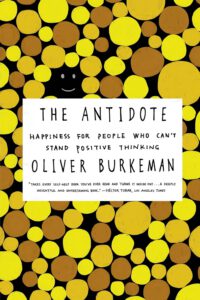
Subtitled “Happiness for People Who Can’t Stand Positive Thinking,” it’s essentially a “counter-attack” on the billion-dollar self-help industry that tells...
Subtitled “Happiness for People Who Can’t Stand Positive Thinking,” it’s essentially a “counter-attack” on the billion-dollar self-help industry that tells you to visualize success and stay positive at all costs.
The Core Premise: The “Backwards Law”
Burkeman builds on an idea popularized by Alan Watts: The harder you try to feel happy, the more you remind yourself that you aren’t. By obsessively chasing “positive” states, we actually increase our anxiety and sense of failure.
Instead, Burkeman suggests the “Negative Path”—the radical idea that the way to find true security and calm is to move toward the things we usually spend our lives running away from: failure, uncertainty, and death.
The 4 Pillars of the “Negative Path”
1. The Stoic “Premeditation of Evils”
Instead of “positive visualization,” the Stoics practiced proactive pessimism. By imagining the absolute worst-case scenario and realizing you could survive it, the fear of the unknown loses its power over you.
The Takeaway: Optimism makes you fragile; “defensive pessimism” makes you resilient.
2. Embracing Failure (The Museum of Failed Products)
Burkeman visits a facility in Michigan that houses thousands of failed grocery store products. He argues that our culture’s obsession with “success” makes us terrified to experiment.
3. The Power of “Non-Doing” (Buddhism)
Drawing on Zen principles, Burkeman discusses the importance of sitting with uncomfortable emotions rather than trying to “fix” or “solve” them immediately. Sometimes, the most productive thing you can do is acknowledge that things are currently a mess.
4. Memento Mori (The Reality of Death)
In a surprisingly upbeat chapter, he visits Mexico during the Day of the Dead. He argues that by acknowledging our mortality, we stop sweating the small stuff and start focusing on what actually matters in our limited time.
Why It’s a 2026 Cult Favorite
While published in 2012, this book has seen a massive resurgence in the mid-2020s. Following the “productivity burnout” of the early 2020s, Burkeman’s philosophy has become a cornerstone of the “Anti-Hustle” movement.
It’s often read alongside his 2021 bestseller, Four Thousand Weeks: Time Management for Mortals, which applies these same “negative” principles to how we manage our schedules.