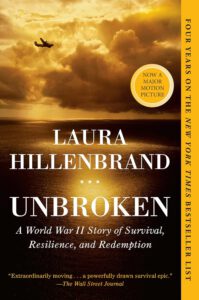
by Laura Hillenbrand
14 discussion topics
2010
⭐ 4.39
“Unbroken: A World War II Story of Survival, Resilience, and Redemption” (2010) by Laura Hillenbrand is a non-fiction tour de...
“Unbroken: A World War II Story of Survival, Resilience, and Redemption” (2010) by Laura Hillenbrand is a non-fiction tour de force. It chronicles the life of Louis “Louie” Zamperini, an Olympic runner whose life story is so improbable that it often feels like fiction.
By 2026, the book remains a staple of modern biography, largely due to Hillenbrand’s meticulous research and her ability to capture the “unbreakable” nature of the human spirit.
Part 1: The Torrance Tornado
The first act follows Louie’s transformation from a juvenile delinquent in Torrance, California, into a world-class athlete.
The Rebel: As a child of Italian immigrants, Louie was a hell-raiser who stole and fought constantly.
The Runner: His brother, Pete, channeled that defiant energy into track. Louie became a superstar, eventually competing in the 1936 Berlin Olympics, where he ran a final lap so fast it caught the attention of Adolf Hitler.
Part 2: 47 Days at Sea
When WWII broke out, Louie became a B-24 bombardier. In 1943, his plane, the Green Hornet, suffered mechanical failure and crashed into the Pacific.
The Raft: Louie, his pilot (Phil), and a tail gunner (Mac) survived on two small life rafts.
The Ordeal: For 47 days, they drifted over 2,000 miles. They survived shark attacks, strafing by Japanese aircraft, and starvation by catching birds and fish with their bare hands. Mac eventually died at sea, but Louie and Phil survived—only to be “rescued” by the Japanese Navy.
Part 3: The Bird and the POW Camps
Louie spent the next two years in a series of brutal POW camps. He became the “number one” target of a sadistic guard named Mutsuhiro Watanabe, nicknamed “The Bird.”
The Psychological War: Because Louie was a famous Olympian, The Bird was obsessed with breaking him. Louie was subjected to medical experiments, slave labor, and constant physical beatings.
Dignity as Survival: Hillenbrand emphasizes that while the guards could take Louie’s health, they couldn’t take his dignity. His “defiant” spirit became his primary tool for survival.
Part 4: The Long Road to Redemption
The war ended, but the “breaking” began when Louie returned home.
The PTSD: Haunted by nightmares of The Bird, Louie spiraled into severe alcoholism and became obsessed with returning to Japan to kill his tormentor.
The Turning Point: In 1949, at the urging of his wife, he attended a Billy Graham tent revival. He experienced a religious conversion that allowed him to finally let go of his hatred.
The Letter: Louie eventually returned to Japan to personally forgive his former captors. He even wrote a letter to “The Bird” (who refused to meet him), stating that his hate had been replaced by love.
Key Themes
Resilience: The idea that the mind and spirit can endure far more than the body.
Forgiveness: The novel argues that the final “victory” over trauma isn’t survival, but the ability to forgive those who caused it.
The “Greatest Generation”: The book serves as a broader tribute to the millions of men who returned from the Pacific with “unseen” wounds.