
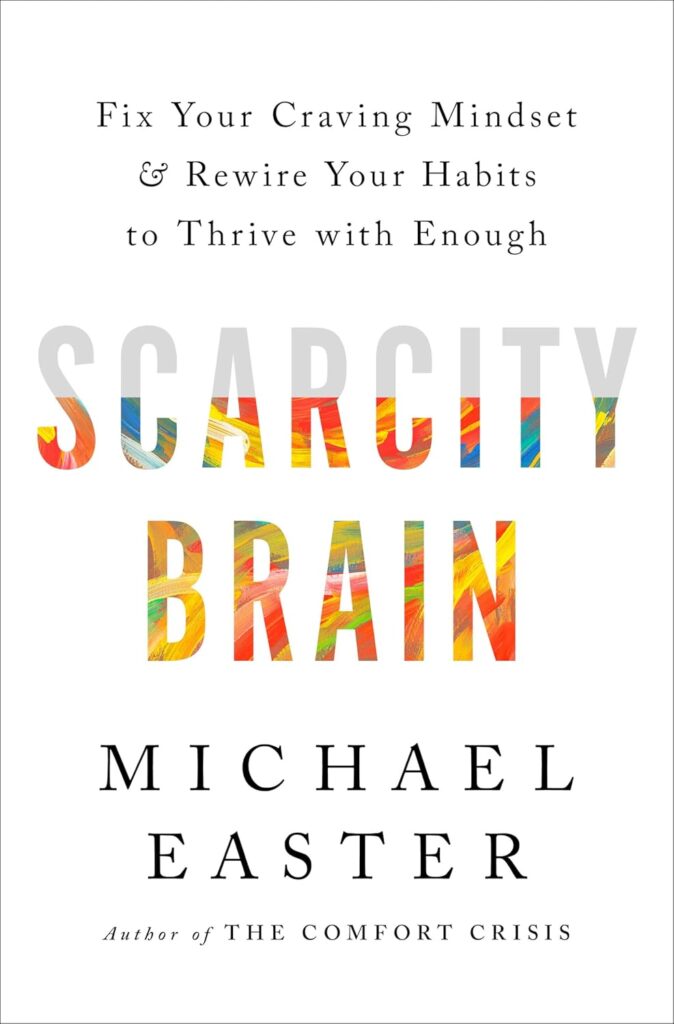
Scarcity Brain
Also available on: Kindle, Audible
Synopsis
Scarcity Brain: Why Our Minds Are Wired for Puffery, Pizza, and Persistence by Michael Easter (2023) is a non-fiction deep dive into the evolutionary “glitch” that keeps us constantly wanting more. While technically a science and self-help crossover, it has gained a massive following in 2025 and 2026 among the “productivity” and “intentional living” communities on social media.
The Core Premise
Easter argues that for 99% of human history, we lived in a world of scarcity (not enough food, information, or resources). Our brains evolved a “scarcity mindset” to help us survive by seeking out and hoarding anything we could find.
However, we now live in a world of abundance (infinite scrolling, 24/7 snacks, 2-day shipping). Our ancient brains haven’t caught up, leading to what he calls the “Scarcity Loop.” This loop—consisting of opportunity, unpredictable rewards, and quick repeatability—is the same mechanism that makes slot machines, TikTok, and modern consumerism so addictive.
Key Concepts
- The Scarcity Loop: Easter identifies the three-part cycle that keeps us hooked:
- Opportunity: You see a chance to get something (a like on a photo, a clearance sale).
- Unpredictable Rewards: You don’t know when or how good the reward will be (the “variable ratio” reinforcement).
- Quick Repeatability: You can do it again immediately.
Why it’s Still Trending
- Digital Detox Movement: In 2026, as people become more wary of AI-driven algorithms designed to keep them scrolling, this book serves as a “user manual” for how to fight back.
- The “Clutter” Backlash: It’s a favorite for the “Minimalism” and “Quiet Life” movements, providing the biological “why” behind our urge to over-consume.
- Michael Easter’s Brand: Following the success of his previous book, The Comfort Crisis, Easter has become a leading voice in “evolutionary health,” helping people understand how to live better in a world that is “too easy.”