Michael Easter
About the Author
Books by Michael Easter (2)
Scarcity Brain
14 discussion topics
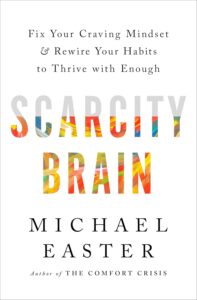
Scarcity Brain: Why Our Minds Are Wired for Puffery, Pizza, and Persistence by Michael Easter (2023) is a non-fiction deep dive into the evolutionary “glitch” that keeps us constantly wanting more. While technically a science and self-help crossover, it has gained a massive following in 2025 and 2026 among the “productivity” and “intentional living” communities on social media.
The Core Premise
Easter argues that for 99% of human history, we lived in a world of scarcity (not enough food, information, or resources). Our brains evolved a “scarcity mindset” to help us survive by seeking out and hoarding anything we could find.
However, we now live in a world of abundance (infinite scrolling, 24/7 snacks, 2-day shipping). Our ancient brains haven’t caught up, leading to what he calls the “Scarcity Loop.” This loop—consisting of opportunity, unpredictable rewards, and quick repeatability—is the same mechanism that makes slot machines, TikTok, and modern consumerism so addictive.
Key Concepts
- The Scarcity Loop: Easter identifies the three-part cycle that keeps us hooked:
- Opportunity: You see a chance to get something (a like on a photo, a clearance sale).
- Unpredictable Rewards: You don’t know when or how good the reward will be (the “variable ratio” reinforcement).
- Quick Repeatability: You can do it again immediately.
Why it’s Still Trending
- Digital Detox Movement: In 2026, as people become more wary of AI-driven algorithms designed to keep them scrolling, this book serves as a “user manual” for how to fight back.
- The “Clutter” Backlash: It’s a favorite for the “Minimalism” and “Quiet Life” movements, providing the biological “why” behind our urge to over-consume.
- Michael Easter’s Brand: Following the success of his previous book, The Comfort Crisis, Easter has become a leading voice in “evolutionary health,” helping people understand how to live better in a world that is “too easy.”
The Comfort Crisis
14 discussion topics
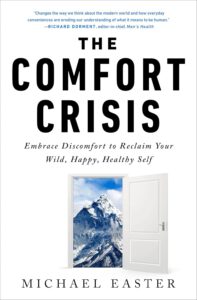
The Comfort Crisis by Michael Easter (2021) is a non-fiction investigative work that explores a paradox of the modern age: while our lives have never been safer or more convenient, we have never been more anxious, physically unfit, or unfulfilled.
Easter, a journalist for Men’s Health and Outside, argues that we are biologically wired for a world of scarcity and challenge, but we are currently drowning in “comfort creep.”
The Core Plot & Narrative
The book is structured around a 33-day backcountry caribou hunt in the Alaskan Arctic. Easter travels with two experienced hunters into one of the most remote places on Earth, carrying only what he can fit on his back.
He uses this “survival epic” as the narrative spine to interweave research-heavy chapters on science and history. Each time he faces a specific hardship in the wild—like extreme hunger, bone-chilling cold, or mind-numbing boredom—he pivots to interview world-class experts (from NBA scientists to Buddhist leaders in Bhutan) to explain why that specific discomfort is actually essential for human health.
Key Concepts & Takeaways
- The Misogi: An ancient Japanese purification ritual repurposed here as a modern challenge. Easter suggests everyone should do one “Misogi” a year: a task so difficult you have a 50% chance of failure, intended to expand your mental and physical limits.
- Comfort Creep: The phenomenon where, as life gets easier, we lower our threshold for what we consider a “problem.” This explains why we get “stressed” by a slow Wi-Fi connection while our ancestors survived ice ages.
- The Nature Pyramid: Research showing that as little as 20 minutes in nature can drop stress levels, but a 3-day “deep dive” in the wild can fundamentally rewire the brain’s creativity and calm.
- Rucking: A major trend sparked by this book. It’s the simple act of walking with a weighted backpack, mimicking how our ancestors traveled and gathered food.
Appeal Notes: Why It’s Buzzing
- The “Anti-Self-Help” Vibe: It doesn’t tell you to “be kind to yourself.” It tells you to be hard on yourself. This “tough love” approach appeals deeply to the “Goggins-style” fitness community and high-performers.
- Scientific Grounding: Unlike many lifestyle books, Easter cites extensive peer-reviewed studies on evolutionary biology and neuroscience to back up his claims.
- Adventure Journal Style: It reads like a thriller. You want to know if he catches the caribou or survives the grizzly bear encounter, which makes the “science lessons” much easier to digest.
- Relatability: Easter begins the book as an “urbanite” struggling with alcohol and a sedentary lifestyle. He isn’t a superhero; he’s a guy trying to get his life back, which makes his advice feel achievable.